

Introduction to Lead-Free Perovskite Solar Cells
The search for efficient, sustainable, and non-toxic solar energy solutions has led researchers to explore innovative materials that could replace conventional silicon-based photovoltaics. Among the most promising candidates are lead-free perovskite solar cells, which offer a cleaner alternative to traditional perovskite structures while maintaining impressive light-harvesting capabilities.
Traditional organometal halide perovskites have dominated perovskite solar cell research due to their exceptional efficiency gains over the past decade. However, the presence of toxic lead in these materials has raised significant environmental and health concerns. This limitation has sparked intense research into lead-free alternatives that can deliver comparable performance without the associated risks.
Understanding A2AgRhF6 Fluoride Double Perovskites
The A2AgRhF6 fluoride double perovskite represents a groundbreaking advancement in the field of photovoltaic materials science. This innovative structure belongs to the double perovskite family, characterized by a unique crystal arrangement that combines silver (Ag), rhodium (Rh), and fluorine (F) in a carefully engineered configuration.
What Makes Double Perovskites Special?
Double perovskites, also known as elpasolites, feature a general formula of A2BB’X6, where two different B-site cations are arranged in a checkerboard pattern within the crystal lattice. This distinctive arrangement offers several advantages:
- Enhanced structural stability compared to simple perovskites
- Improved electronic properties through strategic cation ordering
- Tunable bandgaps achievable by modifying the elemental composition
- Reduced toxicity when lead is completely eliminated from the structure
The Role of Rhodium in Photovoltaic Performance
Rhodium (Rh) plays a crucial role in determining the optoelectronic characteristics of these fluoride double perovskites. As a transition metal with excellent catalytic and electronic properties, Rh contributes to:
- Optimal bandgap tuning for maximum sunlight absorption
- Efficient charge carrier transport within the material
- Enhanced stability against environmental degradation
- Improved overall photovoltaic performance
First-Principles Calculations: Peering into the Atomic Level
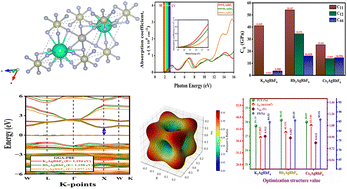
First-principles calculations, also known as ab initio methods, represent a powerful computational approach that allows scientists to predict material properties based on fundamental physical laws without relying on experimental data. These calculations provide invaluable insights into the behavior of A2AgRhF6 fluoride double perovskites at the atomic and electronic levels.
Key Insights from Computational Studies
Through sophisticated density functional theory (DFT) simulations, researchers have uncovered several critical findings about lead-free double perovskites:
- Structural Optimization: First-principles studies help determine the most stable crystal configuration and identify potential phase transitions under various conditions.
- Electronic Structure Analysis: These calculations reveal the band structure, density of states, and charge distribution, which are essential for understanding light absorption and charge transport properties.
- Defect Physics: Computational methods enable researchers to investigate defect formation and migration, which significantly impact material performance and stability.
- Thermodynamic Stability: First-principles calculations predict the stability of different compositions and help identify the most promising candidates for experimental synthesis.
Device Simulation: From Theory to Practical Applications
While first-principles calculations reveal the fundamental properties of materials, device simulation bridges the gap between atomic-scale understanding and real-world solar cell performance. These simulations model the complete device structure, including:
- Active layer (perovskite absorber)
- Electron transport layer (ETL)
- Hole transport layer (HTL)
- Front and back electrodes
Performance Metrics Predicted by Device Simulation
Advanced device simulations provide predictions for critical photovoltaic parameters:
- Power Conversion Efficiency (PCE): The primary metric for evaluating solar cell performance
- Open-Circuit Voltage (Voc): Maximum voltage generated by the device
- Short-Circuit Current (Jsc): Current produced under illumination
- Fill Factor (FF): Measure of the device’s electrical quality
- Stability under operational conditions: Long-term performance predictions
Advantages of A2AgRhF6 for Photovoltaic Applications
The A2AgRhF6 fluoride double perovskite offers numerous advantages that make it an attractive candidate for next-generation solar cells:
Environmental Benefits
- Complete elimination of toxic lead from the material composition
- Reduced environmental impact during manufacturing and disposal
- Safer handling and processing for researchers and industry workers
Performance Advantages
- Tunable optical bandgap spanning the visible spectrum
- Excellent light absorption coefficients
- Favorable charge carrier mobilities
- Long charge carrier diffusion lengths
Stability Improvements
- Enhanced resistance to moisture and oxygen degradation
- Improved thermal stability compared to organic-inorganic hybrids
- Better structural integrity under continuous illumination
Challenges and Future Directions
Despite the promising characteristics of lead-free A2AgRhF6 fluoride double perovskites, several challenges remain before commercial implementation becomes feasible:
Current Limitations
- Efficiency gaps: Current efficiencies still lag behind lead-based perovskites
- Synthesis complexity: Fabricating high-quality thin films remains challenging
- Rhodium cost: Rh is a rare and expensive element
- Scalability issues: Transitioning from laboratory to industrial production
Promising Research Directions
Future research efforts are focused on:
- Exploring alternative B-site combinations to reduce costs
- Developing novel synthesis methods for improved film quality
- Implementing surface passivation strategies to enhance stability
- Creating tandem solar cell architectures to maximize efficiency
Conclusion
The exploration of lead-free A2AgRhF6 fluoride double perovskites represents a significant milestone in the quest for sustainable and efficient photovoltaic technologies. Through the combined power of first-principles calculations and device simulation, researchers can accelerate the discovery and optimization of these promising materials.
While challenges remain, the environmental benefits and improving performance metrics of lead-free double perovskites make them strong contenders for the future of solar energy. As computational methods continue to advance and experimental techniques improve, we can expect to see these innovative materials play a crucial role in the global transition toward clean, renewable energy sources.
The journey from theoretical predictions to commercial solar panels is long, but the combination of computational insights and practical experimentation provides a clear pathway forward for A2AgRhF6 fluoride double perovskite solar cells.

Comments are closed, but trackbacks and pingbacks are open.