

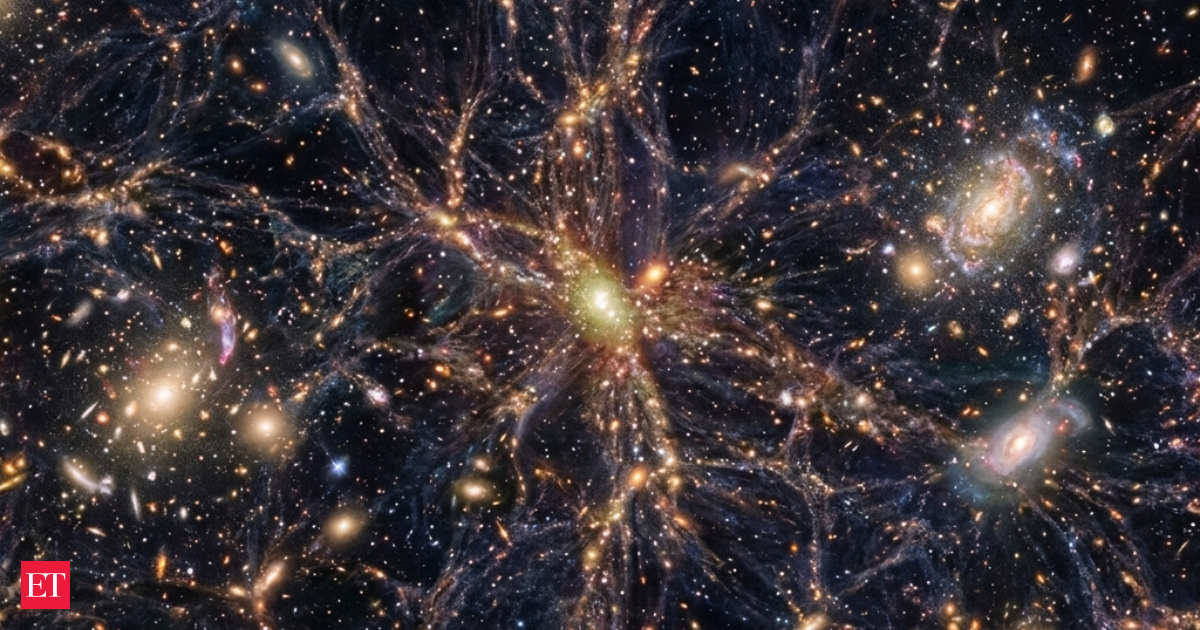
Imagine a filament of dark matter and galaxies stretching across billions of light-years—a cosmic river of matter flowing through the vast emptiness of space. Now, scientists have made a startling discovery: these enormous cosmic structures might not be stationary at all. They could be spinning.
This finding, emerging from cutting-edge astronomical research, has the potential to revolutionize our understanding of how the universe evolved. If confirmed, it would mean that some of the largest structures in the cosmos are rotating on scales never before imagined.
What Are These Giant Cosmic Structures?
The universe isn’t randomly filled with galaxies. Instead, matter organizes into an intricate pattern known as the cosmic web—a vast network of filaments, sheets, and clusters that span billions of light-years.
These structures include:
- Galaxy filaments – Long, thread-like concentrations of galaxies and dark matter
- Superclusters – Massive groupings of multiple galaxy clusters
- Cosmic voids – Vast empty spaces between the filaments
For decades, astronomers believed these massive structures formed through gravitational collapse without any significant net rotation. The new research challenges this fundamental assumption.
The Groundbreaking Discovery
Researchers analyzing data from large-scale sky surveys noticed something unexpected: certain galaxy filaments appear to show coherent rotational motion. This means entire rivers of galaxies and dark matter are spinning like giant cosmic pinwheels.
"We’re talking about structures that span billions of light-years," explained one researcher. "The angular momentum involved is almost incomprehensible."
The evidence comes from studying the motion of galaxies within these filaments. Instead of moving randomly or falling directly toward dense regions, galaxies in certain filaments show patterns consistent with orbital motion around the filament’s axis—essentially, the entire structure is rotating.
How Do Cosmic Structures Rotate?
Understanding how such massive structures could rotate requires looking back to the early universe. In the infant cosmos, tiny density fluctuations—slight variations in the distribution of matter—provided the seeds for future structure.
As gravity pulled matter together, these fluctuations grew into the filaments and clusters we see today. The new research suggests that some of these primordial fluctuations may have possessed intrinsic angular momentum that was amplified as the structures grew.
Think of it like water swirling down a drain—the initial slight rotation gets amplified as matter concentrates. On cosmic scales, this could mean the rotation we observe today is a fossil of the universe’s earliest moments.
Why This Matters
This discovery has profound implications for cosmology:
1. Understanding Cosmic Origins
If large-scale rotation exists, it tells us something fundamental about the initial conditions of the universe and how structure formed.
2. Testing Dark Matter Models
The behavior of cosmic filaments provides a unique laboratory for testing our models of dark matter—the invisible substance that makes up most of the universe’s mass.
3.Revising Simulations
Current cosmological simulations will need to account for this rotation, potentially requiring significant updates to our theoretical frameworks.
What Comes Next?
Scientists are now working to confirm these observations using additional data and more sophisticated analysis techniques. Upcoming telescopes and surveys will provide even more detailed views of the cosmic web, allowing researchers to map the motions of galaxies with unprecedented precision.
The mystery of cosmic rotation represents one of the most exciting frontiers in modern astronomy. As we continue to observe and understand these massive structures, we may uncover new secrets about the fundamental nature of our universe.
Conclusion
The possibility that giant cosmic structures are rotating across billions of light-years opens a new chapter in our understanding of the cosmos. What we once thought of as static, gravity-bound formations may instead be dynamic, spinning entities that carry the imprint of the universe’s earliest moments.
As research continues, we stand on the brink of potentially rewriting major sections of our cosmic history books. The universe, it seems, still has plenty of surprises to reveal.

Comments are closed, but trackbacks and pingbacks are open.