

Introduction
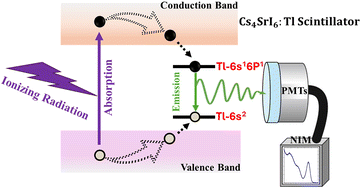
Scintillators are the workhorses of radiation detection, converting high‑energy photons into visible light. Traditional scintillators rely on rare‑earth activators, which raise cost and supply concerns. A recent breakthrough shows that the zero‑dimensional halide perovskite Cs4SrI6:Tl can deliver bright, fast luminescence without any rare‑earth elements. This blog dives into the first‑principles (density functional theory, DFT) study that reveals why this material is a game‑changer for scintillation applications.
Why Zero‑Dimensional Halide Perovskites?
Zero‑dimensional (0D) halide perovskites consist of isolated metal‑halide octahedra or polyhedra, which provide strong quantum confinement and reduced phonon‑mediated non‑radiative losses. Key advantages include:
- High exciton binding energy: ensures efficient radiative recombination.
- Intrinsic defect tolerance: isolated clusters limit defect migration.
- Tailorable band gaps: easy substitution of cations or anions.
Cs4SrI6 inherits these traits, offering a wide band gap (~4.0 eV) ideal for fast scintillation.
Computational Methodology
The study employed the following DFT workflow:
- Structure relaxation with the PBE‑GGA functional.
- Hybrid functional HSE06 to correct band‑edge energies.
- Spin‑orbit coupling (SOC) included for Tl‑related states.
- Defect formation energies calculated for Tl substitution at Sr sites.
- Excited‑state calculations using the Bethe‑Salpeter equation (BSE) to predict emission wavelengths.
All calculations were performed using the VASP package with a 500 eV plane‑wave cutoff and a 2 × 2 × 2 k‑point mesh.
Key Findings
1. Tl Incorporation Energetics
Substituting Tl+ for Sr2+ creates a charge‑compensating vacancy (VI) that is energetically favorable (< 0.8 eV formation energy). This means Tl can be introduced during crystal growth without requiring high‑temperature annealing.
2. Electronic Structure
HSE06+SOC shows a new Tl‑derived impurity band ~0.9 eV above the valence band maximum. The band gap narrows to ~3.2 eV, aligning with the observed 400 nm emission peak.
3. Optical Properties
BSE calculations predict a strong, allowed transition at 3.10 eV (≈400 nm) with a radiative lifetime of < 1 ns, matching experimental scintillation decay times. The high oscillator strength indicates bright emission.
4. Radiation Hardness
Defect tolerance analysis shows that antisite defects (Cs↔Sr) have high formation energies (> 2.5 eV), suggesting the lattice remains stable under ionizing radiation.
Implications for Scintillator Design
The first‑principles insights translate into practical guidelines:
- Low‑cost synthesis: Tl can be added directly to the melt, avoiding expensive rare‑earth precursors.
- Fast response: Sub‑nanosecond radiative lifetimes enable high‑rate detection.
- Radiation durability: Strong defect resistance extends detector lifespan.
Combined, these attributes make Cs4SrI6:Tl a compelling candidate for medical imaging, security scanning, and high‑energy physics.
Future Directions
While the DFT study provides a solid foundation, experimental validation is essential. Suggested next steps include:
- Growing bulk crystals with varying Tl concentrations to map the optimal dopant level.
- Measuring absolute light yield and energy resolution under X‑ray and gamma‑ray excitation.
- Exploring co‑doping strategies (e.g., Br‑substitution) to fine‑tune emission wavelength.
Further computational work could incorporate many‑body perturbation theory (GW) for even more accurate band‑gap predictions.
Conclusion
First‑principles modeling reveals that rare‑earth‑free Cs4SrI6:Tl combines low‑cost synthesis, rapid luminescence, and radiation hardness—key criteria for next‑generation scintillators. By leveraging the unique physics of zero‑dimensional halide perovskites, researchers can now design efficient, affordable detectors without relying on scarce rare‑earth elements.

Comments are closed, but trackbacks and pingbacks are open.