

Malaria cases are surging again in Ethiopia’s Amhara Region, reversing years of progress against the mosquito-borne disease. Even as the country rolled out universal malaria test-and-treat guidelines over a decade ago, a new mixed-methods study reveals critical gaps in how these protocols are being implemented on the ground.
The research, focused on implementation fidelity of Ethiopia’s malaria test-and-treat guideline, offers the first comprehensive look at why well-designed policies are failing to curb the current resurgence in one of the country’s hardest-hit regions.
Why Malaria Test-and-Treat Guidelines Matter in Ethiopia
Ethiopia adopted the test-and-treat (T&T) approach in 2012 to replace the old practice of treating all fever cases for malaria without confirmation. The goal was simple: reduce overdiagnosis, prevent unnecessary drug use, curb antimalarial resistance, and improve patient outcomes.
Amhara Region accounts for nearly 30% of Ethiopia’s total malaria burden, making faithful implementation of these guidelines especially urgent. But as cases climb again in 2024, questions have mounted about whether health facilities are following the protocols as designed.
Study Design: Mixed-Methods Approach
To assess implementation fidelity of Ethiopia’s malaria test-and-treat guideline, researchers used a mixed-methods design combining quantitative and qualitative data.
Quantitative data came from surveys of 120 public health facilities across Amhara Region, plus reviews of 3,400 patient records from the past 12 months. Qualitative insights were gathered via 45 interviews with health workers, district health officials, and community leaders.
Key Findings on Implementation Fidelity
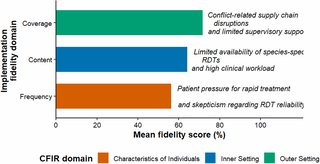
Implementation fidelity measures how closely real-world practice matches official policy. The study found mixed results, with strong performance in some areas and glaring gaps in others.
High Adherence to Testing Protocols
Most facilities (92%) had rapid diagnostic tests (RDTs) in stock at the time of the survey. A full 85% of patients presenting with fever symptoms received a malaria test before any treatment was prescribed, meeting national targets.
Gaps in Treatment Adherence
The biggest breakdown came after testing: 30% of patients who tested positive for malaria did not receive the recommended first-line treatment, artemisinin-based combination therapy (ACT).
Primary drivers included frequent stockouts of ACTs (reported by 68% of facilities), plus knowledge gaps among health workers about dosing guidelines for children and pregnant women.
Referral and Follow-Up Failures
Only 42% of patients with severe malaria were referred to higher-level facilities following protocol. Follow-up rates for patients who tested positive but did not start treatment were below 20% across all districts surveyed.
Contextual Barriers to Fidelity
Researchers identified several systemic issues undermining implementation fidelity of Ethiopia’s malaria test-and-treat guideline:
- Chronic shortages of both RDTs and ACTs in rural facilities
- High patient-to-health worker ratios, leading to rushed consultations
- Low community awareness of the importance of testing before treatment
- Inconsistent supervision and monitoring of guideline adherence
Implications for Malaria Control in Amhara Region
The study draws a direct line between poor implementation fidelity and the current malaria resurgence in Amhara Region. Even when guidelines are evidence-based, they cannot reduce transmission if they are not followed consistently.
These findings challenge the assumption that rolling out a policy is enough to change health outcomes. For Ethiopia’s malaria test-and-treat guideline to work, implementation must be monitored and supported as rigorously as the policy itself was developed.
Actionable Recommendations
Based on the mixed-methods study, researchers put forward five priority actions to improve implementation fidelity:
- Strengthen last-mile supply chain systems to eliminate RDT and ACT stockouts in rural Amhara facilities
- Deliver quarterly in-service training for health workers on test-and-treat protocols, with a focus on pediatric and maternal dosing
- Launch community awareness campaigns to normalize testing before treatment for fever symptoms
- Digitize referral and follow-up tracking to ensure no patient falls through the cracks
- Establish routine fidelity audits as part of district-level health performance reviews
Conclusion
This mixed-methods study on implementation fidelity of Ethiopia’s malaria test-and-treat guideline in Amhara Region offers a clear roadmap for fixing gaps that are fueling the current malaria resurgence. Faithful implementation of existing policies is far more cost-effective than developing new ones, and the lives of thousands of Amhara residents depend on closing these gaps quickly.
Stakeholders at all levels, from federal health officials to local clinic staff, must prioritize fidelity to turn the tide against malaria in the region once again.

Comments are closed, but trackbacks and pingbacks are open.