

The artificial intelligence revolution has created an unprecedented challenge for data centers worldwide. As AI workloads demand exponentially more computational power, the heat generated by modern processors has reached levels that traditional air cooling systems simply cannot handle. This has sparked a wave of innovation in data center cooling technology, with companies adopting startup agility while achieving enterprise-scale impact.
The Heat Crisis in Modern Data Centers
Today’s AI accelerators and high-performance GPUs generate heat densities that would have been unimaginable just a decade ago. A single modern AI chip can produce over 700 watts of thermal energy—compare that to a traditional server CPU that might output 250 watts. When you cluster hundreds of these processors together in a single rack, the heat dissipation requirements become staggering.
Traditional air cooling systems were designed for a different era. They rely on moving vast amounts of air through server rooms, consuming enormous amounts of energy and requiring massive physical footprints. For the AI era, this approach is not just inefficient—it’s becoming physically impossible.
Liquid Cooling: The New Standard
The shift toward liquid cooling represents the most significant transformation in data center thermal management. Unlike air, liquid has a dramatically higher heat capacity, meaning it can absorb and carry away far more thermal energy per unit of volume. This fundamental physics advantage makes liquid cooling essential for high-density AI deployments.
Direct-to-Chip Cooling
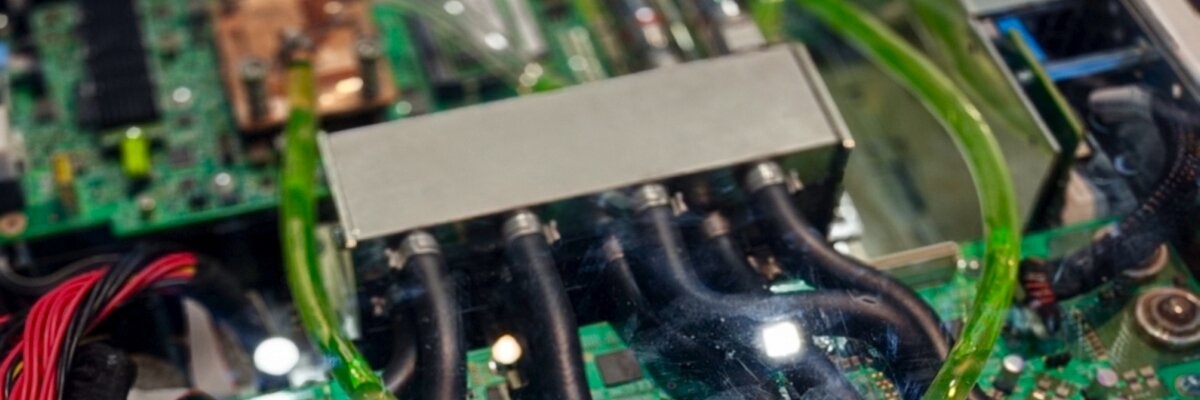
Direct-to-chip cooling involves placing cold plates directly on top of processors and other heat-generating components. Coolant circulates through these plates, absorbing heat directly at the source before it can spread throughout the system. This approach offers several key advantages:
- Higher efficiency: Direct heat removal reduces energy consumption by up to 40% compared to traditional air cooling
- Lower operating temperatures: Processors can run cooler and more reliably, extending hardware lifespan
- Reduced noise: Eliminating massive fan arrays creates quieter data center environments
- Higher density: More compute power can be packed into smaller spaces
Immersion Cooling: Complete Submersion
For the most demanding AI workloads, some operators are turning to immersion cooling—submerging entire servers in specially designed non-conductive liquids. This approach treats heat removal as a completely solved problem, allowing for unprecedented compute densities.
Companies implementing immersion cooling report achieving 5-10x the compute density of traditional air-cooled facilities. The initial investment is higher, but the operational savings and performance benefits are compelling for AI-focused operations.
Startup Innovation Meets Enterprise Scale
What’s remarkable about the current transformation in cooling technology is how it’s being driven by a new generation of companies that combine startup agility with enterprise ambitions. These organizations are developing breakthrough cooling solutions that address the specific challenges of AI computing while maintaining the reliability and scalability that data center operators require.
The "built like a startup, scaled like Cisco" approach means these companies are:
- Rapidly iterating on cooling designs based on real-world AI workload feedback
- Building modular, scalable solutions that can grow with demand
- Focusing on sustainability alongside performance
- Creating ecosystems of partners and integrators
Sustainability and Efficiency
Beyond performance, modern cooling solutions are increasingly designed with environmental sustainability in mind. Data centers consume approximately 1-2% of global electricity, and cooling accounts for a significant portion of that energy use. New cooling technologies are addressing this challenge on multiple fronts:
Reduced energy consumption: Advanced liquid cooling systems can reduce cooling energy use by 30-50% compared to traditional approaches.
Heat reuse: The thermal energy removed from data centers can be captured and used for building heating, industrial processes, or even agricultural applications.
Water conservation: Modern closed-loop cooling systems use significantly less water than traditional evaporative cooling towers.
Lower PUE: Power Usage Effectiveness, the key metric for data center energy efficiency, can be dramatically improved with advanced cooling technologies.
The Future of Data Center Cooling
As AI workloads continue to grow in complexity and scale, cooling technology will remain a critical differentiator for data center operators. The companies that successfully combine innovative cooling approaches with reliable, scalable implementations will be well-positioned to support the next generation of AI infrastructure.
The transformation is already underway. Major cloud providers, colocation operators, and enterprise data centers are actively deploying advanced cooling solutions. The question is no longer whether to adopt new cooling technologies, but how quickly they can be implemented at scale.
For organizations planning AI infrastructure investments, cooling technology should be a primary consideration. The right cooling solution can enable higher performance, lower operating costs, and greater sustainability—all critical factors in building successful AI operations for the long term.

Comments are closed, but trackbacks and pingbacks are open.