

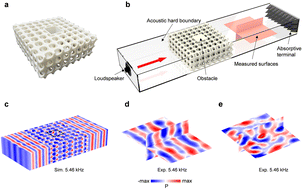
Struggling to control high-frequency sound waves for medical imaging or noise cancellation? A new breakthrough in acoustic metamaterials might have the solution.
Researchers have developed a triply periodic minimal surface (TPMS)-based acoustic crystal that exhibits a double-zero index – a rare property that lets sound waves pass through with almost no distortion. This triply periodic minimal surface acoustic crystal could transform how we design everything from ultrasound machines to underwater sonar systems.
What Is a Triply Periodic Minimal Surface (TPMS)?
Triply periodic minimal surfaces are 3D geometric structures that repeat infinitely in all three spatial directions, with zero mean curvature at every point. You might recognize their swirling, porous patterns from 3D printed art, biomedical scaffolds, or even high-end architecture.
Why TPMS for Acoustic Crystals?
Traditional acoustic crystals use rigid, periodic lattices to block or bend sound waves. TPMS structures, by contrast, have highly tunable porosity and surface area that lets engineers precisely control sound wave interactions without adding bulky weight.
Key advantages of using triply periodic minimal surface designs for acoustic applications include:
- Uniform pore distribution for consistent wave behavior across the entire material
- Lightweight, 3D printable design that cuts manufacturing costs
- Tunable geometry to target specific sound frequencies for custom use cases
What Is a Double-Zero Index Acoustic Crystal?
In acoustics, a double-zero index material has both zero effective mass density and zero effective bulk modulus. For sound waves, this means the material behaves like a low-distortion pathway – waves travel through it with no reflection, scattering, or phase change.
Most materials slow down or bend sound waves as they pass through. A double-zero index acoustic crystal does the opposite: it lets sound waves propagate with the same speed and shape as they would in open air, but within a solid, structured material.
How TPMS Enables Double-Zero Index Properties
Achieving double-zero index properties is notoriously difficult with traditional bulk materials. You need to balance two competing factors: reducing effective mass density while also lowering bulk modulus to near zero.
TPMS structures solve this by using their thin, curved walls to create localized resonances that cancel out the material’s natural acoustic properties. Researchers tune the TPMS geometry – adjusting pore size, wall thickness, and unit cell shape – to hit that exact double-zero sweet spot for target frequencies.
Real-World Applications of This Breakthrough
This triply periodic minimal surface acoustic crystal with double-zero index is not just a lab curiosity. It has tangible use cases across multiple industries:
- Medical Ultrasound: Double-zero index crystals focus sound waves more precisely, improving resolution for prenatal ultrasounds, tumor imaging, and non-invasive surgeries.
- Underwater Sonar: Reduced wave distortion delivers clearer, longer-range sonar signals for submarines, marine research, and offshore energy inspections.
- Noise Control: Architectural panels made with this material block specific noise frequencies without making rooms feel echoey or muffled.
- Acoustic Holography: Manipulate sound waves to create 3D audio experiences or contactless haptic feedback for VR and AR systems.
Current Limitations and Future Research
While the breakthrough is exciting, we’re still in early stages of commercialization. Most current TPMS double-zero index crystals only work for narrow frequency ranges, limiting their immediate use.
Scaling up production of complex 3D TPMS structures also remains costly, as it requires high-precision 3D printing or lithography. Researchers are now working on multi-material TPMS designs to expand the operating frequency range, and partnering with manufacturing firms to lower production costs.
What’s Next for TPMS Acoustic Crystals?
Triply periodic minimal surface-based acoustic crystals with double-zero index are a perfect example of how abstract geometry can solve real-world engineering problems. As production methods improve, we can expect to see these materials in hospital imaging suites, smart home devices, and marine research tools.
Have questions about how TPMS structures work, or ideas for how this double-zero index acoustic crystal could be used in your field? Drop them in the comments below – we’d love to hear from you!

Comments are closed, but trackbacks and pingbacks are open.