

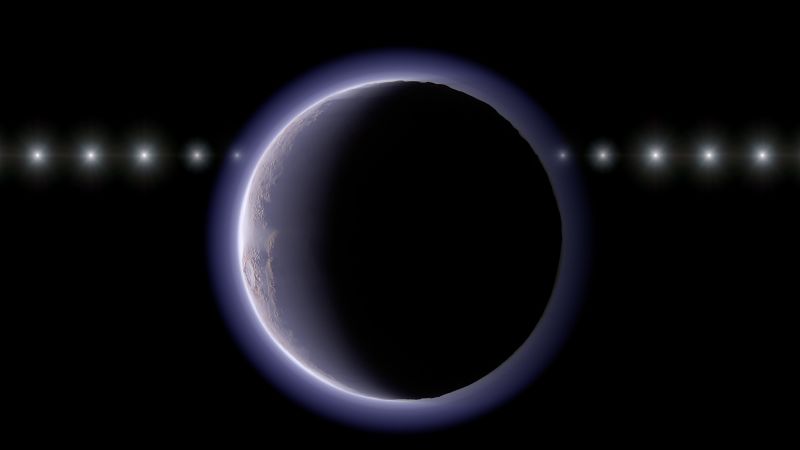
What the Discovery Means
When astronomers announced they had spotted a faint atmosphere around a small, distant solar‑system object, the news sparked excitement across the planetary science community. Unlike the thick blankets of gas surrounding the giant planets, this envelope is barely detectable, yet it provides critical clues about how bodies at the edge of the Solar System evolve.
Why a Small Object Can Hold an Atmosphere
- Volatile Retention: Even objects only a few tens of kilometers across can trap ices of nitrogen, methane, or carbon monoxide beneath a thin surface layer.
- Solar Heating Cycle: During perihelion, increased solar radiation can sublimate surface ices, releasing gas that temporarily forms an exosphere.
- Cosmic Impacts: Micrometeorite collisions can liberate gas trapped in the regolith, adding to a transient atmosphere.
How Scientists Detected the Gas
The detection relied on a combination of high‑resolution spectroscopy and stellar occultation measurements:
- Spectroscopic Signatures: By pointing large telescopes at the object’s reflected sunlight, researchers identified faint absorption lines matching nitrogen and methane.
- Occultation Light Curves: As the object passed in front of a background star, the star’s light dimmed in a way that indicated a surrounding gaseous halo.
- Radio Science: Radio waves from distant spacecraft showed a slight delay when the signal grazed the object, confirming the presence of a thin ionized layer.
Implications for Solar System Formation
This finding reshapes several long‑standing ideas:
- Early Atmosphere Loss: It suggests that many small bodies may have once possessed much richer atmospheres that were stripped away over billions of years.
- Surface Chemistry: A persistent gas envelope can drive chemical reactions on the surface, creating complex organics that might seed future moons or comets.
- Classification Challenges: The line between "dwarf planet" and "large comet" becomes blurrier when an object can temporarily sustain an atmosphere.
Future Observations
To confirm and expand on this discovery, scientists plan:
- Deploying space‑based UV spectrographs during the object’s next perihelion passage.
- Coordinating global occultation networks to capture high‑precision light curves.
- Launching a CubeSat flyby mission to directly sample the exosphere.
Conclusion
Detecting an atmosphere around a small, distant solar system object proves that even the tiniest members of our planetary family can hold secrets about the Solar System’s past. As technology improves, we can expect more surprising discoveries that will keep the frontier of planetary science alive and evolving.

Comments are closed, but trackbacks and pingbacks are open.