

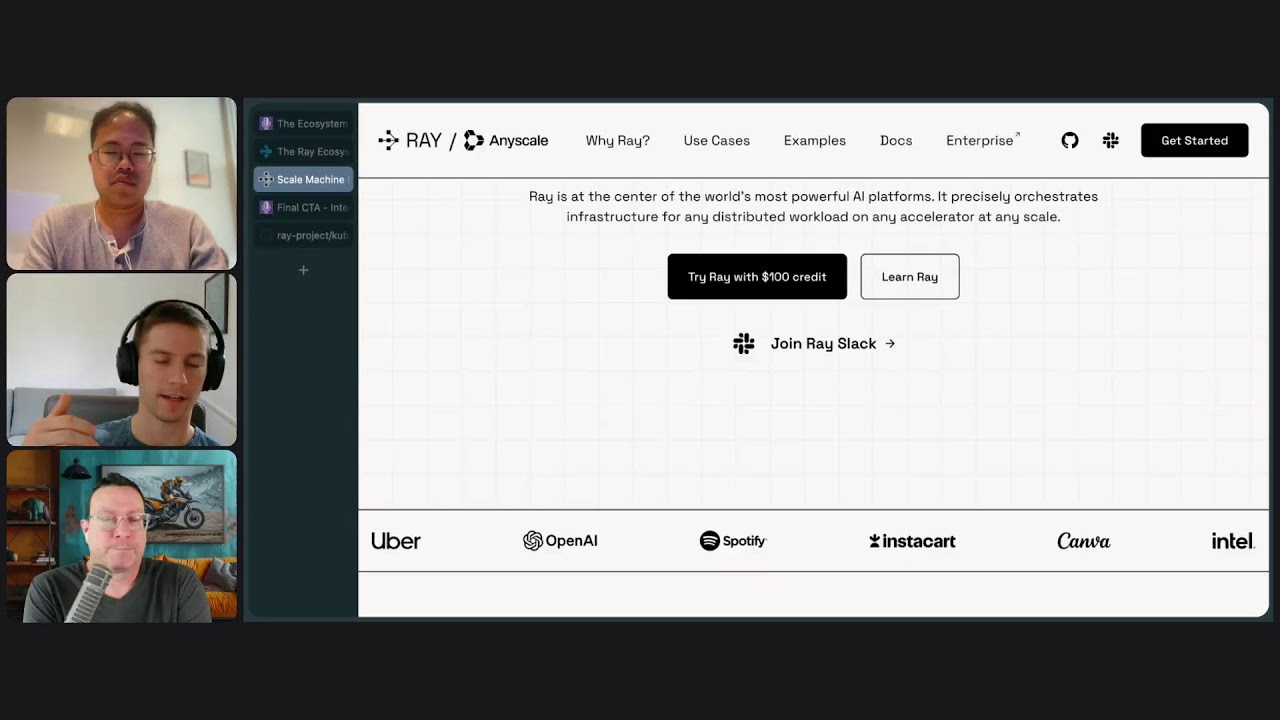
If you’re a Python developer who’s ever struggled to speed up CPU-heavy workloads, you’ve probably hit the limits of Python’s Global Interpreter Lock (GIL). Traditional multiprocessing works for small tasks, but scaling to distributed systems is a nightmare. Enter Ray — and the latest Talk Python to Me #547 episode breaks down exactly how this tool unlocks parallel Python at any scale.
Host Michael Kennedy sits down with Robert Nishihara, co-founder of Ray and UC Berkeley alum, to discuss how Ray solves decade-old pain points for Python developers. Whether you’re a beginner curious about distributed computing or an ML engineer scaling production workloads, this episode delivers actionable insights.
What Is Talk Python to Me #547 All About?
The episode, titled Parallel Python at Any Scale with Ray, dives deep into Ray’s origins, core architecture, and real-world use cases. Robert shares how Ray was born out of UC Berkeley research to simplify distributed computing for everyday Python users — no PhD in distributed systems required.
Who’s on the Episode?
- Michael Kennedy: Host of Talk Python to Me, Python educator, and co-author of multiple Python books.
- Robert Nishihara: Co-founder of Ray, former UC Berkeley researcher, and main contributor to Ray’s core codebase.
Why Ray Matters for Python Developers
Python’s GIL means even multi-threaded code can’t fully utilize multi-core CPUs. Traditional workarounds like multiprocessing are brittle, hard to debug, and impossible to scale across multiple machines. Ray changes that with a lightweight, unified framework.
It works seamlessly from a single laptop core to a 1000-node cluster — no code changes required. You write the same Python code for prototyping and production, which cuts down on development time and bugs.
Key Pain Points Ray Solves
- Python’s GIL limits true multi-core parallelism for CPU-bound tasks.
- Traditional multiprocessing fails to scale across machines or cloud environments.
- Legacy distributed frameworks have steep learning curves and heavy dependencies.
- No standard way to run parallel workloads from prototype to production.
Core Takeaways from Episode #547
The episode covers practical, actionable insights you can apply immediately. Here are the top takeaways:
- Ray is not just for big data: it works for ML training, data ETL, web scraping, and scientific simulations.
- Ray has near-zero overhead: it starts in seconds, with no heavy Java or Scala dependencies.
- Scaling is seamless: add
ray.init(address="auto")to connect to an existing cluster, no code rewrites. - Native integrations with PyTorch, TensorFlow, Pandas, and Scikit-learn — no custom wrappers needed.
- Ray AI Runtime (AIR) simplifies end-to-end ML workflows, from training to deployment.
Real-World Use Cases Mentioned
- Training large language models (LLMs) across multiple GPUs and nodes.
- Running thousands of parallel physics simulations for climate research.
- Processing terabytes of user data for real-time ETL pipelines.
- Serving ML models with low latency at global scale.
How to Get Started with Ray (Beginner-Friendly Steps)
You don’t need a cluster to start using Ray. Here’s how to write your first parallel Python script in 5 minutes:
- Install Ray via pip:
pip install ray - Write a simple remote function using the
@ray.remotedecorator:
import ray # Initialize Ray (runs locally by default) ray.init() # Mark function as remote to run in parallel @ray.remote def multiply(a, b): return a * b # Submit 10 parallel tasks futures = [multiply.remote(i, 2) for i in range(10)] # Wait for all tasks to finish and get results results = ray.get(futures) print(results) # Output: [0, 2, 4, 6, 8, 10, 12, 14, 16, 18] # Shut down Ray ray.shutdown() - Test locally, then scale to a cluster by changing
ray.init()toray.init(address="auto")to connect to an existing Ray cluster.
Who Should Listen to This Episode?
- Python developers frustrated with slow CPU-bound workloads.
- ML engineers looking to scale model training and inference.
- Data engineers building large-scale ETL or processing pipelines.
- Beginners who want to learn distributed computing concepts without jargon.
Final Verdict
Talk Python to Me #547 is a must-listen for any Python developer working with parallel or distributed workloads. Michael and Robert break down complex distributed systems concepts into simple, relatable terms, and the real-world examples make it easy to see how Ray fits into your workflow.
You can listen to the full episode here, or find it on all major podcast platforms. Have you tried Ray for your Python projects? Let us know in the comments below.

Comments are closed, but trackbacks and pingbacks are open.