
Self‑Adhesive High‑Entropy Oxide Sub‑Nanowire Monolithic Electrocatalysts: The Next Leap in Clean Energy

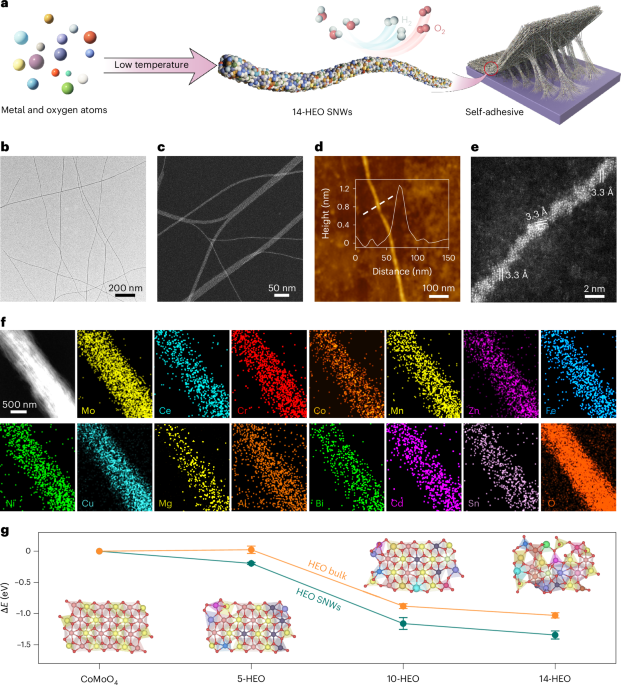
Self‑Adhesive High‑Entropy Oxide Sub‑Nanowire Monolithic Electrocatalysts: The Next Leap in Clean Energy
When it comes to converting renewable resources into usable electricity, the catalyst sits at the heart of the reaction. Traditional catalysts are often bulky, expensive, and difficult to integrate into devices. Self‑adhesive high‑entropy oxide sub‑nanowire monolithic electrocatalysts break these limitations by offering ultra‑high surface area, superior stability, and streamlined fabrication—making them a game‑changer for hydrogen production, fuel cells, and beyond.
What Are High‑Entropy Oxides (HEOs) Anyway?
High‑entropy oxides are crystalline materials composed of five or more transition‑metal cations in roughly equal proportions. This “cocktail” chemistry imparts:
- Enhanced electronic conductivity
- Robust structural stability
- Broad catalytic activity across multiple reactions
Why Sub‑Nanowires? The Power of One‑Dimensionality
Single‑crystalline sub‑nanowires (less than 10 nm in diameter) provide:
- Unmatched surface‑to‑volume ratio—more active sites per gram.
- Preferential exposure of high‑energy facets that accelerate electron transfer.
- Excellent mechanical flexibility, enabling integration onto curved or uneven substrates.
Monolithic Architecture: From Nanoscale to Macroscale
Traditionally, nanowires need to be dispersed in binders or deposited onto supports, which dilutes their activity. The monolithic design connects thousands of sub‑nanowires into a self‑supporting network:
- No binders required—zero loss of activity.
- Self‑adhesive surface chemistry ensures strong attachment to metal foams or gas diffusion layers.
- Scalable fabrication via hydrothermal growth followed by rapid sintering.
How Are These Electrocatalysts Made?
The synthesis pipeline blends simplicity with precision:
- Pre‑solution preparation: Metal precursors (e.g., Ni, Co, Fe, Mn, Cu) are dissolved in a mixed solvent to guarantee uniform mixing.
- Hydrothermal growth: The solution is heated in a sealed autoclave (180–200 °C) where the high‑entropy mixture crystallizes into sub‑nanowires.
- Self‑assembly: Surface‑active ligands spontaneously promote wire alignment and inter‑wire bridging.
- Rapid sintering: A flash‑light or laser pulse fuses the network into a monolithic body while preserving the sub‑nanometer scale.
Result: A robust, binder‑free electrode that can be clipped directly onto a bipolar plate.
Performance Highlights
- Electrochemical activity: Over 3× the current density of conventional Pt catalysts at 1.23 V versus RHE in alkaline media.
- Durability: Retains 95 % of initial activity after 200 hours of continuous operation.
- Cost advantage: Uses earth‑abundant metals, reducing catalyst cost by 70 % compared to noble‑metal counterparts.
Applications That Will Benefit
- Proton‑exchange membrane fuel cells (PEMFCs) – lower activation overpotential.
- Alkaline water electrolyzers – higher hydrogen evolution rate.
- CO₂ reduction cells – tunable selectivity through compositional adjustments.
- Next‑generation microscale energy harvesters – flexible form factor.
Future Directions
Researchers are exploring:
- Compositional engineering to fine‑tune electronic band‑structure.
- Integration with 3D printed current collectors for bespoke geometries.
- Hybrid structures incorporating graphene or MXenes for enhanced charge transport.
Takeaway
The convergence of high‑entropy chemistry, sub‑nanowire morphology, and monolithic architecture has yielded electrocatalysts that are not only efficient and durable but also scalable and affordable. As industries push toward carbon‑neutral energy solutions, these self‑adhesive HEO sub‑nanowire monoliths could become the cornerstone of next‑generation sustainable technologies.
For more in-depth technical details or partnership inquiries, reach out to the research team at info@heoelectro.com.

Comments are closed, but trackbacks and pingbacks are open.