

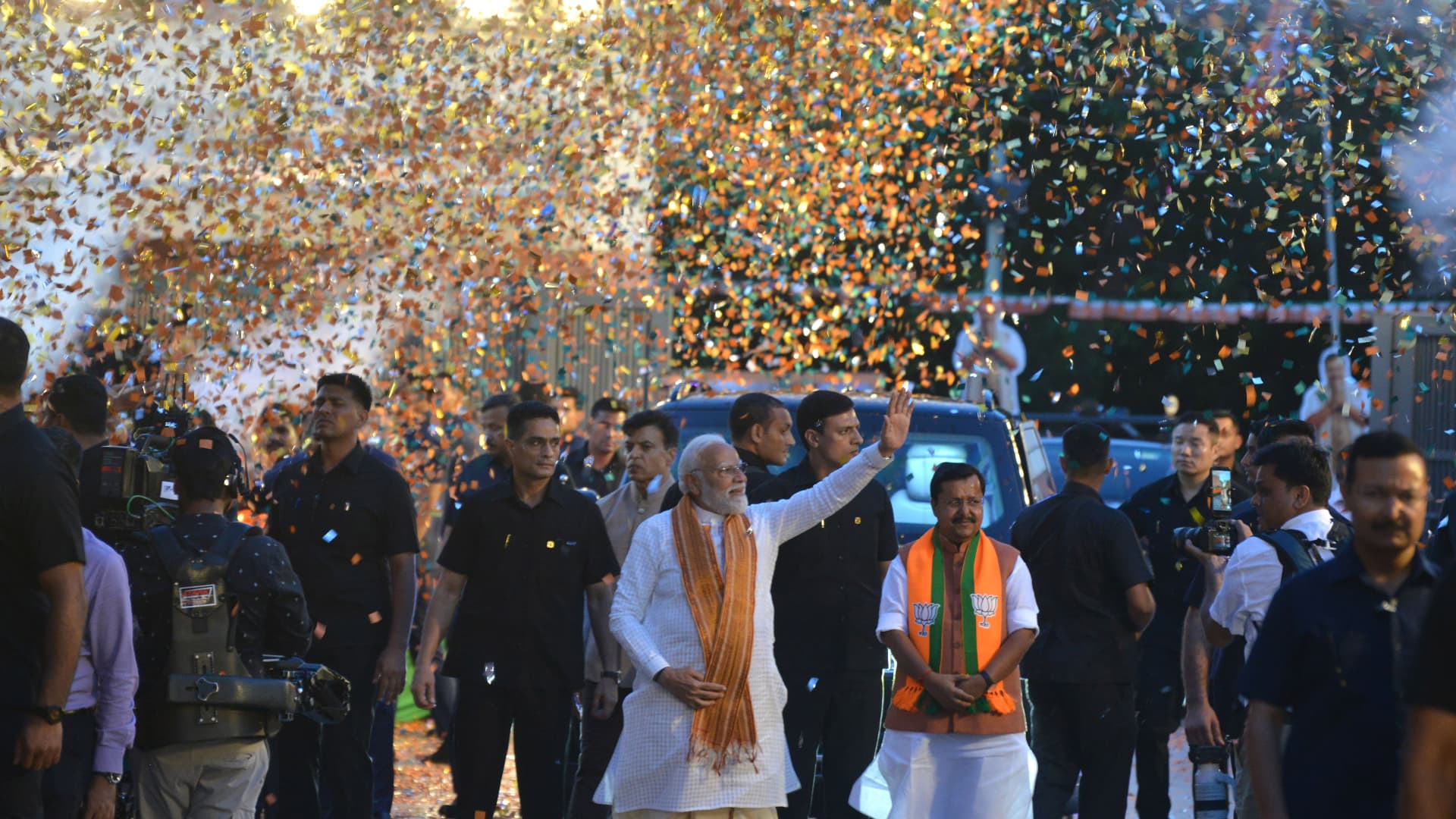
Prime Minister Narendra Modi has achieved what many considered impossible — a landslide victory in India’s most politically crucial state. The BJP’s emphatic win in Uttar Pradesh has not only strengthened Modi’s political grip but also raised hopes for transformative reforms and renewed investor interest in India’s economy.
The Historic Victory That Redefined Indian Politics
In what political analysts are calling a watershed moment, Modi’s Bharatiya Janata Party secured a overwhelming majority in Uttar Pradesh, India’s most populous state with over 200 million voters. This wasn’t just another election win — it was a mandate that reshaped the political landscape of the nation.
The victory margin surprised even the most optimistic projections. With the BJP crossing the 300-seat mark in a 403-member assembly, Modi demonstrated that his political machinery remains unmatched in Indian politics. This win follows the party’s earlier success in Gujarat, reinforcing Modi’s image as an unbeatable electoral force.
What Made This Victory Different
- Youth outreach: The BJP successfully connected with young voters through digital campaigns and employment-focused messaging
- Women’s support: Record women voter turnout tilted decisively in favor of the BJP
- Caste coalition: The party managed to transcend traditional caste politics with a unified development narrative
- Organizational strength: The RSS-backed ground machinery worked seamlessly with Modi’s charisma
Political Implications: A Nation Under One Vision
With Uttar Pradesh secured, Modi’s political dominance is now unchallengeable at the national level. The victory provides him with a clear mandate to push his reform agenda without the political hesitation that often accompanies coalition governments.
This state win essentially transforms Modi from a popular prime minister into an indispensable political figure. The opposition, already fragmented, now faces an even steeper challenge in mounting any credible challenge to the BJP’s supremacy.
The Road Ahead for Political Reforms
With such overwhelming political capital, several reforms become possible:
- Land acquisition laws: Streamlining the complex land acquisition process that has delayed infrastructure projects
- Labor law modernization: Updating archaic labor regulations to attract modern manufacturing
- Taxation reforms: Further simplifying the GST framework introduced in 2017
- Agricultural reforms: Implementing market-oriented policies in the farming sector
- Administrative restructuring: Improving governance efficiency at state and district levels
Can This Victory Attract Global Investors?
For global investors, political stability often translates into policy predictability. Modi’s strengthened position offers exactly that — a government that can push through reforms without fearing electoral backlash in the near term.
Investor Positives
The investment case for India has several compelling elements following this victory:
- Policy continuity: Investors can expect consistent economic policies for the foreseeable future
- Infrastructure push: The government can now accelerate major infrastructure projects without political interference
- Make in India boost: Manufacturing incentives are likely to receive stronger implementation
- Market stability: Political certainty reduces country risk premium for foreign investors
- Reform momentum: The victory provides political capital to tackle difficult economic reforms
Challenges That Remain
Despite the political mandate, investors should also consider potential obstacles:
- Bureaucratic inertia remains a significant hurdle in implementing policies
- State-level coordination with non-BJP ruled states could present challenges
- Global economic headwinds including inflation and interest rate hikes pose external risks
- Social issues and regional aspirations require sensitive handling
The Economic Promise: What’s at Stake
India’s economy stands at a critical juncture. With a GDP of over $3 trillion, the nation aims to become a $5 trillion economy in the coming years. Modi’s political mandate could be the catalyst needed to accelerate this growth trajectory.
Sectors likely to benefit include infrastructure, manufacturing, real estate, and financial services. The government’s focus on self-reliance (Atmanirbhar Bharat) combined with openness to foreign investment creates a balanced economic approach that appeals to both domestic and international investors.
What Global Markets Are Saying
Initial market reactions have been positive. The Indian stock markets rallied on election results day, reflecting investor confidence in Modi’s continued leadership. Foreign institutional investors have also shown renewed interest in Indian equities.
However, sustainable investor interest depends on actual implementation of reforms. The market will be watching closely for:
- Budget allocations and fiscal discipline
- Infrastructure spending announcements
- Foreign direct investment policy changes
- Progress on ease of doing business reforms
- Resolution of banking sector NPAs
Conclusion: A New Chapter for India
Modi’s historic state victory represents more than just an electoral triumph — it signals the beginning of a potentially transformative period for India. The political stability this creates offers a unique opportunity to push through economic reforms that have been pending for decades.
For investors, the message is clear: India under Modi offers political predictability, reform potential, and growth opportunities. While challenges remain, the direction is positive. Those looking at long-term investment opportunities in one of the world’s fastest-growing major economies would be wise to watch how Modi translates this political mandate into economic action.
The coming months will reveal whether this electoral mandate translates into the reforms and investor confidence that India desperately needs to achieve its economic potential. One thing is certain — the political landscape has shifted dramatically, and the world is watching.

Comments are closed, but trackbacks and pingbacks are open.