

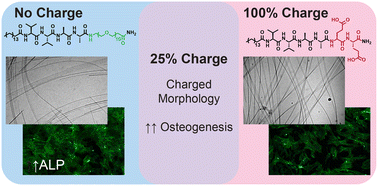
Welcome to the World of Nonionic Peptide Amphiphiles
Imagine a molecule that can self‑assemble into nanowires, fibers, or membranes while remaining stealthy to the immune system. That’s the magic of nonionic peptide amphiphiles (NPAs). They combine a hydrophilic peptide segment with a hydrophobic tail, yet they carry no net charge. This unique feature allows them to modify surface charge densities without provoking unwanted electrostatic interactions, making them perfect tools for biomedical engineering.
Why Charge Matters in Bioactive Materials
Cell‑surface receptors, growth factor binding, and protein adsorption all hinge on the electrical landscape presented by a material. A high positive charge can attract negatively charged proteins but may also trigger cell membrane disruption. Conversely, a negative surface can repel certain proteins but may enhance interaction with positively charged cell receptors. Fine‑tuning the charge density is therefore critical for tailoring bioactivity.
NPAs: The Silent Architects of Charge Distribution
1. Structuring the Amphiphiles
NPAs are engineered by attaching short peptide sequences to a hydrophobic alkyl chain (e.g., palmitic or stearic acid). The peptides are designed to be nonionic—often rich in glycine, alanine, or valine—so the primary charge remains neutral. However, the peptide’s side chains can act as “charge anchors” when arranged in a supramolecular assembly.
2. Self‑Assembly Pathways
- Micelles: Small spherical structures suitable for drug delivery.
- Fibers: One‑dimensional scaffolds that mimic the extracellular matrix.
- Bilayers: Thin films ideal for bio‑interface coatings.
Each form exposes different functional groups, allowing precise control over the local charge environment.
Co‑Assembly: Combining Forces for Enhanced Function
Co‑assembling NPAs with other charged or functional molecules can modulate bioactivity in several ways:
- Charge Patch Formation: Integrating a positively charged peptide segment (e.g., a poly‑arginine motif) into the NPA matrix creates micro‑domains that attract negatively charged biomolecules.
- Improved Mechanical Stability: Adding a small amount of anionic surfactant can balance the electrostatic forces, leading to stronger fibers.
- Responsive Release: Embedding a pH‑sensitive linker within the NPA structure triggers charge change and payload release under acidic tumor microenvironments.
Practical Applications
1. Tissue Engineering Scaffolds
By layering NPAs with growth factor‑binding sequences, researchers create scaffolds that not only support cell attachment but also sequester and release growth factors in a controlled manner.
2. Targeted Drug Delivery
NPAs can encapsulate hydrophobic drugs within their cores. Surface charge tuning ensures that the carriers avoid nonspecific protein adsorption, prolonging circulation time.
3. Bio‑Sensing Platforms
Integrating electroactive peptides with NPAs produces responsive surfaces that change impedance in the presence of specific biomarkers—a promising approach for real‑time diagnostics.
Designing Your Own NPA System
- Define the Target Biomolecule: Determine whether you need attraction or repulsion.
- Select Peptide Motifs: Use nonionic residues for background, add charged modules for functionality.
- Choose the Hydrophobic Tail: Length affects assembly type (longer tails favor fibers).
- Test Assembly Conditions: pH, ionic strength, and temperature can shift the morphology.
- Characterize Charge Density: Employ zeta potential and surface plasmon resonance to fine‑tune.
Conclusion
Nonionic peptide amphiphiles, especially when co‑assembled with complementary molecules, offer a versatile toolbox for tailoring surface charge and, consequently, bioactivity. Their ability to self‑organize into controlled nanostructures while remaining electrically neutral gives scientists a powerful platform to engineer next‑generation biomaterials with precision.

Comments are closed, but trackbacks and pingbacks are open.