

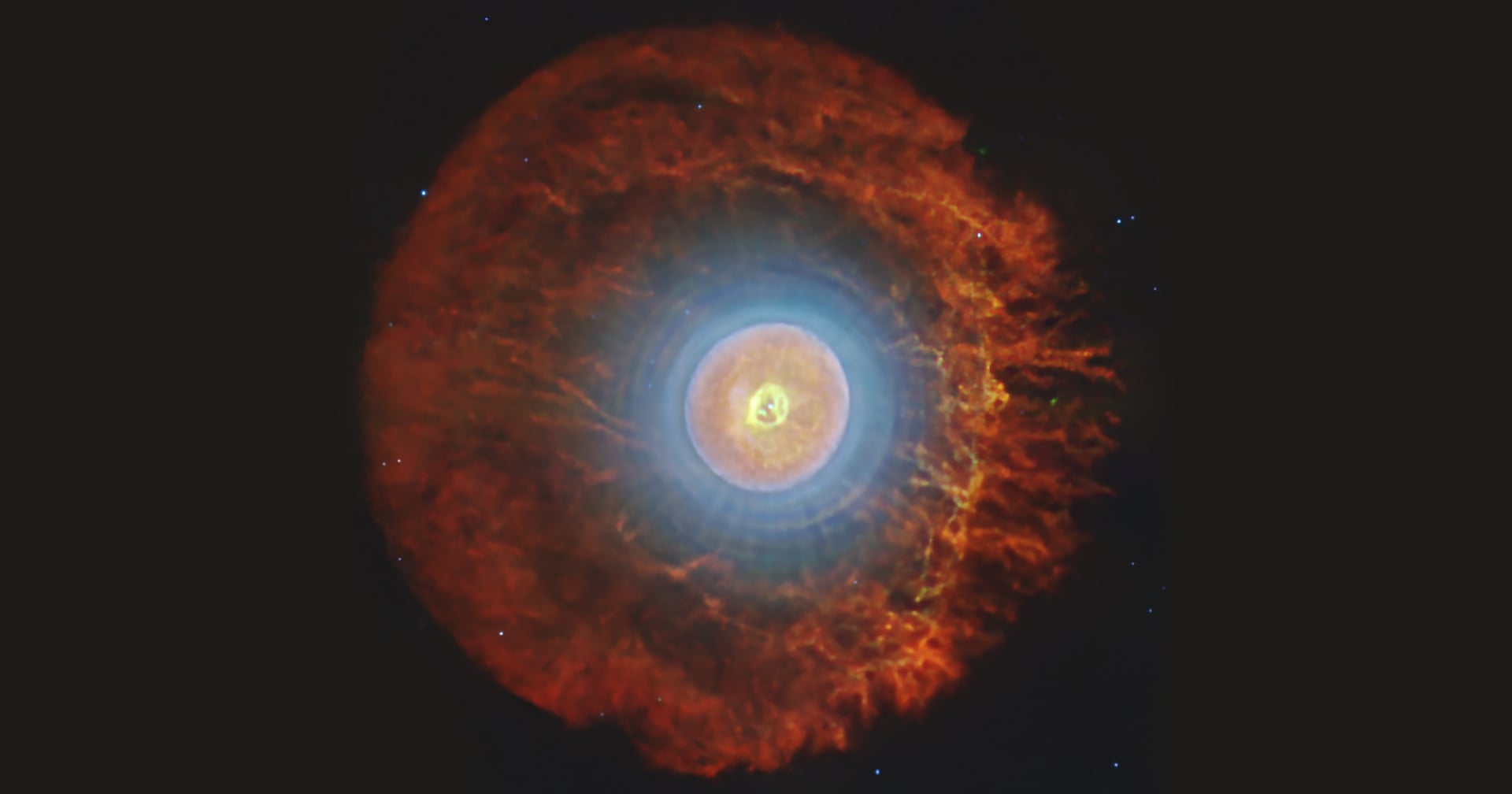
Cosmic buckyballs — those fascinating carbon spheres floating through space — have finally been traced back to their origins. Astronomers at Western University in Ontario, Canada, have pinpointed exactly where these mysterious molecules are born in the universe.
What Are Cosmic Buckyballs?
Buckyballs, formally known as fullerenes, are spherical molecules made of 60 carbon atoms arranged in a shape resembling a soccer ball. They were first discovered in space in 2010, but scientists have long debated where they actually form.
These molecules are surprisingly common in the cosmos. They’ve been found in planetary nebulae, around dying stars, and even in distant galaxies. Yet their formation process remained a stubborn puzzle — until now.
The Breakthrough Discovery
Researchers at Western University used data from the Atacama Large Millimeter/submillimeter Array (ALMA) in Chile to observe the chemical fingerprints of fullerenes in stellar environments.
What they found was striking. Buckyballs don’t just appear randomly in space. They form in specific regions around certain types of stars — particularly in the outflows of carbon-rich stars during late stages of stellar evolution.
Key Findings
- Fullerenes form in the envelopes of asymptotic giant branch (AGB) stars
- The molecular carbon released by these stars condenses into complex structures
- UV radiation from nearby stars helps trigger the final formation of the C60 molecules
- The process takes place in relatively dense and warm stellar winds
Why This Matters
Understanding where buckyballs form in space has implications far beyond astronomy. Fullerenes are a building block for more complex carbon chemistry. They may even play a role in delivering organic molecules to planets — including early Earth.
"This tells us something fundamental about how carbon, one of the key ingredients for life, cycles through the universe," said the lead researcher. "We’re getting closer to understanding the cosmic chemistry that connects stars to planets."
How the Research Was Done
The team combined high-resolution ALMA observations with laboratory spectroscopy. They matched the unique spectral signatures of fullerenes detected in space with controlled experiments here on Earth.
This dual approach — bridging astronomical observation and lab science — is what made the identification possible. Previous studies had hinted at stellar origins, but lacked the precision to confirm it.
What Comes Next
Now that astronomers know where cosmic buckyballs are born, the next question is how they survive and spread. Do they travel intact through interstellar space? Can they seed new planetary systems with carbon-based chemistry?
Future observations with next-generation telescopes, including the James Webb Space Telescope, could reveal how abundant these molecules are and whether they contribute to the organic material found on exoplanets.
The Bigger Picture
This discovery fits into a growing body of research showing that the chemistry of life has deep roots in the cosmos. From amino acids found in meteorites to complex organic molecules drifting through nebulae, the universe is surprisingly fertile ground for the ingredients of biology.
Western University’s team has not only solved a long-standing mystery — they’ve opened a new chapter in astrochemistry research. The birthplace of cosmic buckyballs is now known, and it’s woven into the life cycle of stars themselves.
Stay tuned as astronomers continue unraveling the chemical connections between stars, planets, and the building blocks of life.

Comments are closed, but trackbacks and pingbacks are open.