

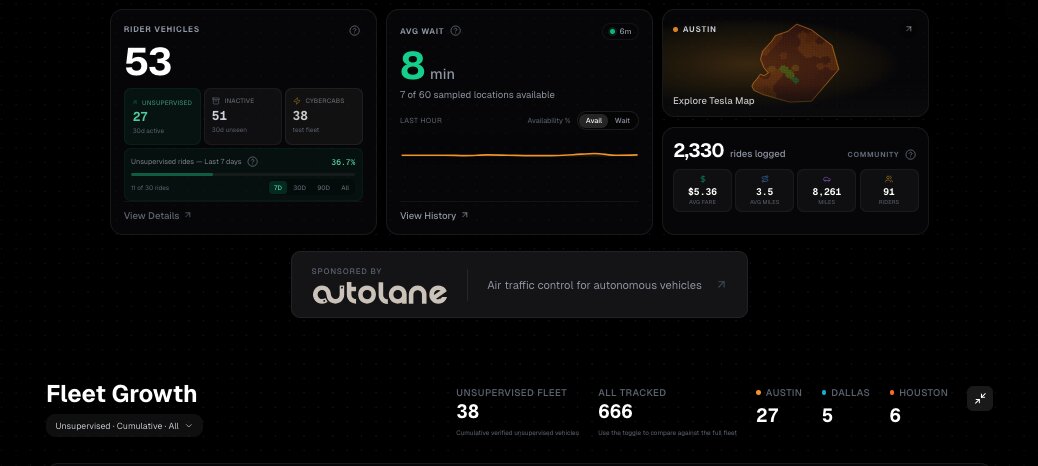
Tesla has hit a major milestone in its self-driving journey: the company now operates at least 38 unsupervised robotaxis across public roads. This marks a significant leap forward for its Full Self-Driving (FSD) technology, moving it closer to commercial robotaxi operations.
For years, Tesla has promised a fully autonomous ride-hailing network, and this latest fleet update signals the company is testing its tech at scale without human safety drivers behind the wheel.
What Counts as an Unsupervised Robotaxi?
Unlike supervised FSD tests, where a human driver must remain ready to take control at all times, unsupervised robotaxis operate without any in-vehicle safety monitor. Tesla’s 38+ units meet this criteria, navigating complex urban and suburban roads independently.
These vehicles use Tesla’s latest FSD V12 software, which relies on end-to-end neural networks to process camera feeds and make real-time driving decisions, rather than hand-coded rules.
Where Are Tesla’s 38+ Robotaxis Operating?
Tesla has not publicly disclosed exact locations for all 38 units, but most are confirmed to be running in Austin, Texas, and parts of California’s Bay Area. These regions offer diverse driving conditions, from heavy city traffic to highway commutes, to stress-test the FSD system.
Early reports from beta testers and local residents note the robotaxis are handling left turns, lane changes, and pedestrian crossings with minimal intervention, a key benchmark for unsupervised operation.
What This Milestone Means for Tesla’s Robotaxi Launch
Reaching 38 unsupervised units is a critical step toward Tesla’s planned 2024 robotaxi launch, which Elon Musk has repeatedly cited as a top priority. Here’s what this fleet growth signals:
- FSD reliability is improving: Operating 38+ units without safety drivers proves the software can handle real-world edge cases at scale.
- Regulatory hurdles are easing: Tesla has secured permits for unsupervised testing in key states, paving the way for commercial operations.
- Competitive edge over rivals: While Waymo and Cruise have larger supervised fleets, Tesla’s camera-only approach and existing customer fleet give it faster scaling potential.
Limitations and Next Steps
While 38 units is a notable milestone, Tesla still faces challenges before launching a public robotaxi service. The current fleet is limited to specific geofenced areas, and harsh weather conditions like heavy rain or snow still pose performance issues for the camera-based system.
Tesla plans to expand the unsupervised fleet to 100+ units by the end of 2024, pending regulatory approval. The company also aims to open the robotaxi network to select Tesla owners in 2025, letting them earn income by adding their personal vehicles to the fleet.
How Tesla’s Robotaxi Compares to Rivals
Waymo currently operates the largest commercial robotaxi fleet in the U.S., with over 700 vehicles in Phoenix, San Francisco, and Los Angeles. However, Waymo uses expensive LiDAR sensors, while Tesla’s camera-only system keeps per-vehicle costs far lower.
Cruise, owned by General Motors, paused operations after a 2023 accident, giving Tesla an opening to catch up in the unsupervised testing space. Tesla’s focus on scaling via its existing 5 million+ vehicle customer base sets it apart from competitors that build custom robotaxi hardware.
Final Thoughts
Tesla’s 38+ unsupervised robotaxi fleet is a clear sign that self-driving tech is moving from beta testing to real-world deployment. For consumers, this means affordable autonomous ride-hailing could arrive sooner than expected.
Stay tuned for further updates as Tesla expands its fleet and works toward a full commercial launch. Will Tesla beat rivals to a nationwide robotaxi rollout? Share your thoughts in the comments below.

Comments are closed, but trackbacks and pingbacks are open.