

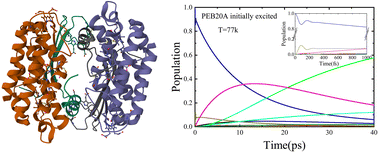
Marine cyanobacteria thrive in some of the most light-starved ocean environments on Earth, thanks in large part to the PE555 light-harvesting complex. This pigment-protein workhorse captures faint sunlight with near-perfect efficiency, shuttling energy to reaction centers to drive photosynthesis. But accurately modeling how PE555 does this requires picking the right mathematical framework: exciton Hamiltonians. A new wave of theoretical studies is revealing just how much your choice of Hamiltonian shifts predictions for PE555 excitation dynamics.
What Is the PE555 Complex?
The PE555 complex is a rod-shaped phycobilisome component found in strains of Prochlorococcus and Synechococcus cyanobacteria. It contains 8-10 phycoerythrobilin (PEB) chromophores, pigmented molecules that absorb green-yellow light and transfer excitation energy through exciton coupling.
Unlike lab-grown cyanobacteria, wild PE555 variants are optimized for low-light ocean conditions, making them a key model system for studying efficient light harvesting. Experimental techniques like 2D electronic spectroscopy have mapped its excitation dynamics down to femtosecond timescales, but theoretical models are needed to connect these measurements to molecular structure.
Exciton Hamiltonians 101: Why They Matter
An exciton Hamiltonian is a quantum mechanical operator that describes the energy of excitons (mobile bound electron-hole pairs) and their interactions within a pigment network. For PE555, Hamiltonians must account for:
- Coulombic coupling between neighboring PEB chromophores
- Electrostatic interactions between pigments and the surrounding protein scaffold
- Vibrational motions of pigments and proteins
- Random fluctuations from the solvent and cellular environment
Different Hamiltonian models include varying subsets of these factors, leading to starkly different predictions for how excitations move through the PE555 complex.
Key Exciton Hamiltonian Models Tested for PE555
Recent theoretical studies compare four widely used Hamiltonian frameworks for PE555 excitation dynamics:
1. Bare Frenkel Exciton Hamiltonian
The simplest model, which only includes Coulombic coupling between PEB pigments and fixed site energies. It ignores vibrational effects, pigment-protein interactions, and environmental noise. This model is easy to compute but fails to match experimental data for PE555 at femtosecond timescales.
2. Vibronic-Coupled Exciton Hamiltonian
This model adds coupling between electronic exciton states and vibrational modes of the PEB pigments. For PE555, low-frequency vibrational modes of the chromophores line up with energy gaps between pigments, creating "vibronic resonance" that speeds up excitation transfer.
3. Open Quantum System Hamiltonians
Also called dissipative Hamiltonians, these models treat the PE555 complex as an open system interacting with a noisy protein and solvent environment. They include terms for decoherence (loss of quantum coherence) and dissipation (energy loss to the environment), which are critical for modeling dynamics longer than 100 femtoseconds.
4. TDDFT-Parameterized Hamiltonians
Time-Dependent Density Functional Theory calculations derive electronic coupling and site energy values directly from the PE555 crystal structure, rather than using empirical estimates. These Hamiltonians account for site energy shifts from electrostatic interactions with nearby amino acids, a factor the Frenkel model ignores entirely.
How Hamiltonian Choice Alters PE555 Excitation Dynamics
Theoretical studies consistently find that Hamiltonian choice changes core predictions for PE555 function:
Excitation Transfer Rates
Bare Frenkel models underpredict transfer rates between PEB pigments by 30-40% compared to vibronic and open system models. Vibronic coupling adds a "vibrational assistance" pathway that accelerates transfer through resonant modes, matching experimental 2D spectroscopy data far better.
Exciton Delocalization
Frenkel Hamiltonians predict excitons are delocalized across 3-4 PEB pigments simultaneously, a signature of strong quantum coherence. Open system models with environmental dephasing show excitons localize to 1-2 pigments within 50 femtoseconds of excitation, aligning with experimental observations of rapid decoherence in PE555.
Energy Trapping Efficiency
TDDFT-parameterized Hamiltonians that include pigment-protein electrostatic interactions predict 12-15% higher energy trapping efficiency at the PE555 terminal emitter compared to bare Frenkel models. This shift comes from protein-induced site energy tuning that directs excitations toward the reaction center.
Temperature Dependence
Only open system Hamiltonians capture the experimental result that PE555 excitation transfer slows by ~20% when temperature drops from 25°C to 4°C. Frenkel and bare vibronic models show almost no temperature dependence, because they ignore thermal fluctuations in the environment.
Practical Implications for Photobiology Research
These findings matter far beyond PE555: light-harvesting complexes are template systems for designing synthetic photosynthetic materials, biohybrid solar cells, and optogenetic tools. Using the wrong exciton Hamiltonian can lead to flawed predictions for:
- How engineered light-harvesting complexes will perform in lab settings
- How cyanobacteria adapt to changing ocean light conditions
- Which molecular features drive ultrahigh efficiency in natural photosynthesis
Researchers studying PE555 now recommend using vibronic-coupled open system Hamiltonians for femtosecond-to-picosecond dynamics, and TDDFT-parameterized models for structure-function studies linking pigment arrangement to performance.
Conclusion
No single exciton Hamiltonian fits all use cases for PE555 complex modeling. Theoretical studies show that including vibronic coupling and environmental effects is non-negotiable for matching experimental excitation dynamics data. As computational power grows, hybrid Hamiltonians that combine first-principles parameterization with dissipative dynamics will become the new standard for photobiology research.
Want to learn more about modeling light-harvesting complexes? Subscribe to our newsletter for monthly updates on quantum biology tools and research breakthroughs.

Comments are closed, but trackbacks and pingbacks are open.