

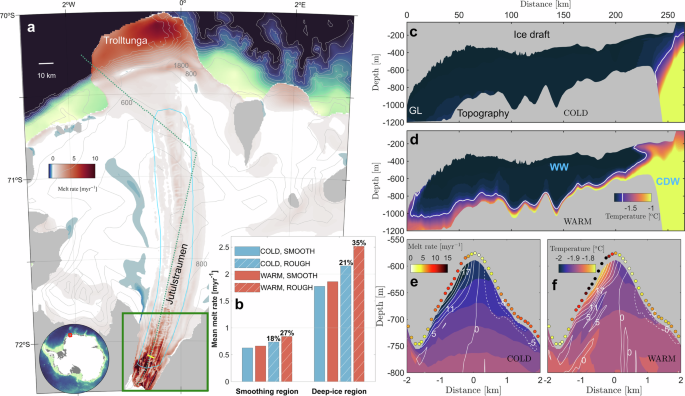
The stability of Antarctic ice shelves plays a crucial role in regulating global sea levels, yet new research reveals a concerning factor that could accelerate their demise. Scientists have discovered that channelized topography significantly amplifies the melt-sensitivity of cold Antarctic ice shelves, potentially leading to faster ice loss than previously understood.
Understanding Antarctic Ice Shelves
Antarctic ice shelves are massive floating extensions of the ice sheet that act as buttresses, slowing the flow of ice from the interior into the ocean. These floating ice platforms can be hundreds of meters thick and span thousands of kilometers. They play a critical role in controlling sea level rise by holding back vast quantities of land-based ice.
While traditionally thought of as relatively stable, especially in colder regions, new research shows that even cold Antarctic ice shelves possess hidden vulnerabilities that make them more sensitive to melting than previously believed.
The Discovery of Channelized Topography
Scientists studying satellite imagery and field data have identified extensive networks of channels and grooves carved into the underside of Antarctic ice shelves. These channelized features are not just random formations but are systematically distributed throughout the ice shelf structure.
These channels form as meltwater and ocean water interact with the ice, carving out pathways that can reach tens of meters deep and hundreds of meters wide. The complex three-dimensional network of these channels creates a unique topography that significantly affects how heat is transferred and distributed within the ice shelf.
How Channelized Topography Amplifies Melt-Sensitivity
The presence of channels dramatically increases the surface area of ice exposed to ocean waters. Instead of a relatively flat bottom, the channelized topography creates a complex, undulating surface that allows for more extensive contact between the ice and warm ocean currents.
Key mechanisms include:
- Enhanced heat transfer through increased surface area
- Formation of circulation patterns that bring warm water deeper into the ice shelf
- Creation of localized hotspots where melting is concentrated
- Accelerated thinning that weakens the ice shelf structure
Feedback Loops and Accelerated Melting
Researchers have identified concerning feedback loops that amplify the melting process. As channels deepen, they create stronger ocean currents, which in turn carve the channels even deeper. This positive feedback loop can lead to exponentially increasing rates of ice loss over relatively short time periods.
Additionally, the channels can create structural weaknesses in the ice shelf, making it more susceptible to fracturing and collapse during extreme weather events or seasonal changes.
Implications for Sea Level Rise
The increased melt-sensitivity of ice shelves with channelized topography has profound implications for global sea level projections. If these ice shelves destabilize more rapidly than current models predict, the acceleration of land-based ice flow could significantly contribute to sea level rise.
Scientists estimate that even a modest increase in ice shelf melting could lead to centimeters of additional sea level rise by the end of this century, potentially impacting coastal communities worldwide.
Climate Models Need Updating
This discovery highlights a critical gap in current climate models. Most models have not adequately accounted for the role of channelized topography in ice shelf melt sensitivity. Researchers are now working to incorporate these findings into improved models that can better predict future ice shelf behavior.
The findings also emphasize the need for continued monitoring of Antarctic ice shelves using advanced satellite technologies and field observations to track changes in channel development and melt rates.
Looking Ahead: Research and Monitoring
International research teams are expanding their focus on understanding the dynamics of channelized ice shelves. This includes deploying autonomous underwater vehicles, installing sophisticated monitoring equipment, and analyzing high-resolution satellite data to track changes in real-time.
Understanding these complex interactions is crucial for developing accurate projections of future sea level rise and for planning adaptation strategies in vulnerable coastal regions.
Conclusion: A Call for Deeper Understanding
The discovery that channelized topography amplifies melt-sensitivity in cold Antarctic ice shelves represents a significant advancement in our understanding of polar climate systems. While the findings are concerning, they also provide valuable insights that can help refine our climate models and improve our ability to predict future changes.
As scientists continue to unravel the complexities of Antarctic ice shelf dynamics, it becomes increasingly clear that even the coldest regions of Earth are responding to climate change in ways that could have profound global consequences. The fate of these ice shelves is inextricably linked to the future of our planet’s coastal communities and ecosystems.

Comments are closed, but trackbacks and pingbacks are open.