

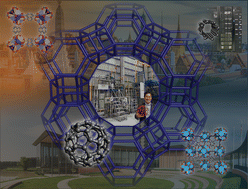
Jumras Limtrakul Turns 72: Honoring a Pioneer in Computational Chemistry & Catalysis
This week marks the 72nd birthday of Professor Jumras Limtrakul, a towering figure in modern computational chemistry and catalysis research. For decades, his work has bridged the gap between theoretical modeling and real-world industrial applications, shaping how scientists design better catalysts for energy, sustainability, and materials science.
Whether you’re a student new to computational chemistry or a researcher tracking advances in catalysis, Limtrakul’s career offers a masterclass in turning complex simulations into tangible impact. Let’s dive into his legacy, and the key advances in the field he’s helped drive forward.
Who is Jumras Limtrakul?
Professor Jumras Limtrakul is a Thai theoretical chemist and professor emeritus at Kasetsart University, where he spent most of his academic career. He served as President of the Science Society of Thailand, and has been recognized with numerous national and international awards for his contributions to chemistry.
His research focuses on using computational methods to solve practical catalysis challenges, a niche that was relatively understudied in Southeast Asia when he started his work in the 1980s. Today, he’s widely credited with building the region’s capacity for high-level computational chemistry research.
Key Advances in Computational Chemistry Driven by His Work
Limtrakul’s work has pushed the boundaries of what computational tools can do for catalysis. Below are three of the most impactful areas he’s contributed to:
Zeolite Catalysis Modeling
Zeolites are porous minerals used in everything from oil refining to water treatment, but their complex structures make experimental trial-and-error for catalyst design slow and expensive. Limtrakul’s team was among the first to use quantum mechanical simulations to predict how modifying zeolite structures would change their catalytic activity.
This work cut years off the catalyst development timeline for industrial partners, and set a standard for how computational chemistry could support experimental catalysis research globally.
Biomass Conversion for Sustainable Fuels
As the world shifted toward renewable energy, Limtrakul turned his attention to biomass conversion: turning agricultural waste into biofuels. His computational models mapped reaction pathways for breaking down cellulose and hemicellulose, identifying low-energy routes that make biofuel production more cost-effective.
His work in this area has been adopted by research groups across Asia, helping accelerate the transition to low-carbon fuel sources.
CO2 Capture and Climate Solutions
More recently, Limtrakul’s team has used computational chemistry to design metal-organic frameworks (MOFs) and other materials for capturing CO2 from industrial flue gases. By simulating how CO2 molecules interact with different material structures, they’ve identified candidates with up to 30% higher capture efficiency than existing commercial options.
This research directly supports global climate goals, proving that computational tools can drive real-world sustainability progress.
The Broader Impact on Catalysis Research
Limtrakul’s influence extends far beyond his own published papers. He’s mentored dozens of PhD students and early-career researchers, many of whom now lead computational chemistry groups across Southeast Asia.
He’s also been a vocal advocate for open access to computational tools, pushing for more equitable access to high-performance computing resources for researchers in developing countries. This work has lowered barriers to entry for the next generation of catalysis scientists.
Key contributions from his career include:
- Over 200 peer-reviewed publications in top chemistry journals
- Development of open-source simulation protocols for zeolite catalysis
- Advisory roles for government and industrial sustainability initiatives
Celebrating 72 Years of Scientific Excellence
As Limtrakul celebrates his 72nd birthday, the computational chemistry and catalysis communities are taking stock of his lasting legacy. His work has proven that theoretical modeling doesn’t have to stay in the lab: it can drive industrial innovation, support climate action, and train the next generation of scientists.
From students running their first density functional theory (DFT) calculations to industrial researchers designing new catalysts for net-zero goals, Limtrakul’s influence is everywhere in the field today.
Conclusion
Professor Jumras Limtrakul’s 72nd birthday is a chance to celebrate not just a brilliant scientist, but a leader who has made computational chemistry and catalysis more accessible, impactful, and relevant to global challenges. His work reminds us that the best science bridges theory and practice, and that mentorship is just as important as research output.
Happy 72nd birthday to Professor Limtrakul – here’s to many more years of advancing the field we all love.

Comments are closed, but trackbacks and pingbacks are open.