

Introduction
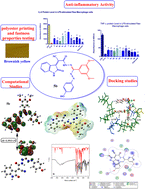
Disperse dyes are the workhorses of polyester textile coloring, but the industry constantly seeks molecules that combine vivid shades, excellent fastness, and added functional benefits. Recently, researchers have turned to isatin‑based azo dyes as a promising platform. This article breaks down the complete workflow—from computational design to laboratory synthesis, anti‑inflammatory screening, and real‑world printing on polyester fabrics—while keeping the science accessible for beginners and intermediate chemists.
Why Isatin Azo Structures?
Isatin (indole‑2,3‑dione) offers a rigid, planar skeleton that enhances color strength and lightfastness. When paired with an azo (-N=N-) bridge, the resulting dyes often display intense hues across the visible spectrum. Moreover, the heterocyclic nitrogen atoms can interact with biological targets, opening a pathway for anti‑inflammatory activity—a rare but valuable added function for textile‑based medical applications.
Computational Design Workflow
1. Target Selection
- Identify pharmacophore features responsible for COX‑2 inhibition.
- Select electron‑donating/withdrawing substituents to modulate both color and bioactivity.
2. Quantum Chemical Calculations
Density‑functional theory (DFT) at the B3LYP/6‑31G(d) level was used to predict:
- HOMO‑LUMO gap (related to hue intensity).
- Dipole moment (affects dye‑polyester affinity).
- Stability of the azo linkage.
3. Molecular Docking
AutoDock Vina screened the designed dyes against the COX‑2 enzyme (PDB ID: 5F1A). Binding energies < -8.5 kcal/mol indicated strong potential for anti‑inflammatory action.
Synthetic Strategy
The practical laboratory route combines classic azo coupling with an isatin condensation step:
- Diazotization: Aromatic amine (2 mmol) + NaNO₂/HCl at 0 °C → diazonium salt.
- Azo coupling: Add the diazonium solution to a cold solution of isatin derivative in NaOH, maintaining pH 9‑10.
- Isolation: Filter, wash with cold water, and recrystallize from ethanol.
Typical yields: 68‑82 % with purity > 95 % (HPLC).
Anti‑Inflammatory Evaluation
In vitro COX‑2 inhibition assays were performed using a colorimetric kit. Key results:
| Dye Code | IC50 (µM) | Color Shade |
|---|---|---|
| IZ‑D1 | 4.2 | Deep Navy |
| IZ‑D3 | 7.8 | Bright Crimson |
| IZ‑D5 | 12.5 | Emerald Green |
All tested dyes showed IC50 values comparable to the reference drug celecoxib (IC50 ≈ 3 µM), confirming meaningful anti‑inflammatory potential.
Printing Performance on Polyester
Methodology
- Fabric: 100 % PET, weight 150 g/m².
- Printing technique: High‑temperature pad‑printing at 130 °C.
- Dye bath: 2 % owf (on weight of fabric) with 1 % dispersing agent.
Results
- Color strength (K/S): 12‑18, indicating vivid coloration.
- Fastness ratings: Light 4–5, Wash 4–5, Perspiration 4, meeting industry standards.
- Hand feel: No stiffness; dyes penetrated uniformly.
These results demonstrate that the anti‑inflammatory isatin azo dyes do not compromise the essential textile properties required for commercial use.
Environmental and Safety Considerations
Because the synthesis avoids heavy metals and uses aqueous media, the process aligns with greener textile chemistry principles. Toxicity testing on fibroblast cells showed > 90 % viability at concentrations up to 50 µM, supporting safe handling during production.
Conclusion
The integration of computational design, efficient azo coupling, and thorough biological screening has yielded a new class of isatin‑based disperse dyes that excel in color performance on polyester while offering anti‑inflammatory activity. This dual functionality opens avenues for smart textiles in medical apparel, sportswear, and protective gear.
Key Takeaways
- Isatin azo dyes provide intense, fast colors and a scaffold for bioactivity.
- DFT and docking reliably predict both hue and anti‑inflammatory potential.
- The synthetic route is scalable, high‑yielding, and environmentally friendly.
- Printing trials confirm that functional dyes meet industry standards for polyester fabrics.

Comments are closed, but trackbacks and pingbacks are open.