

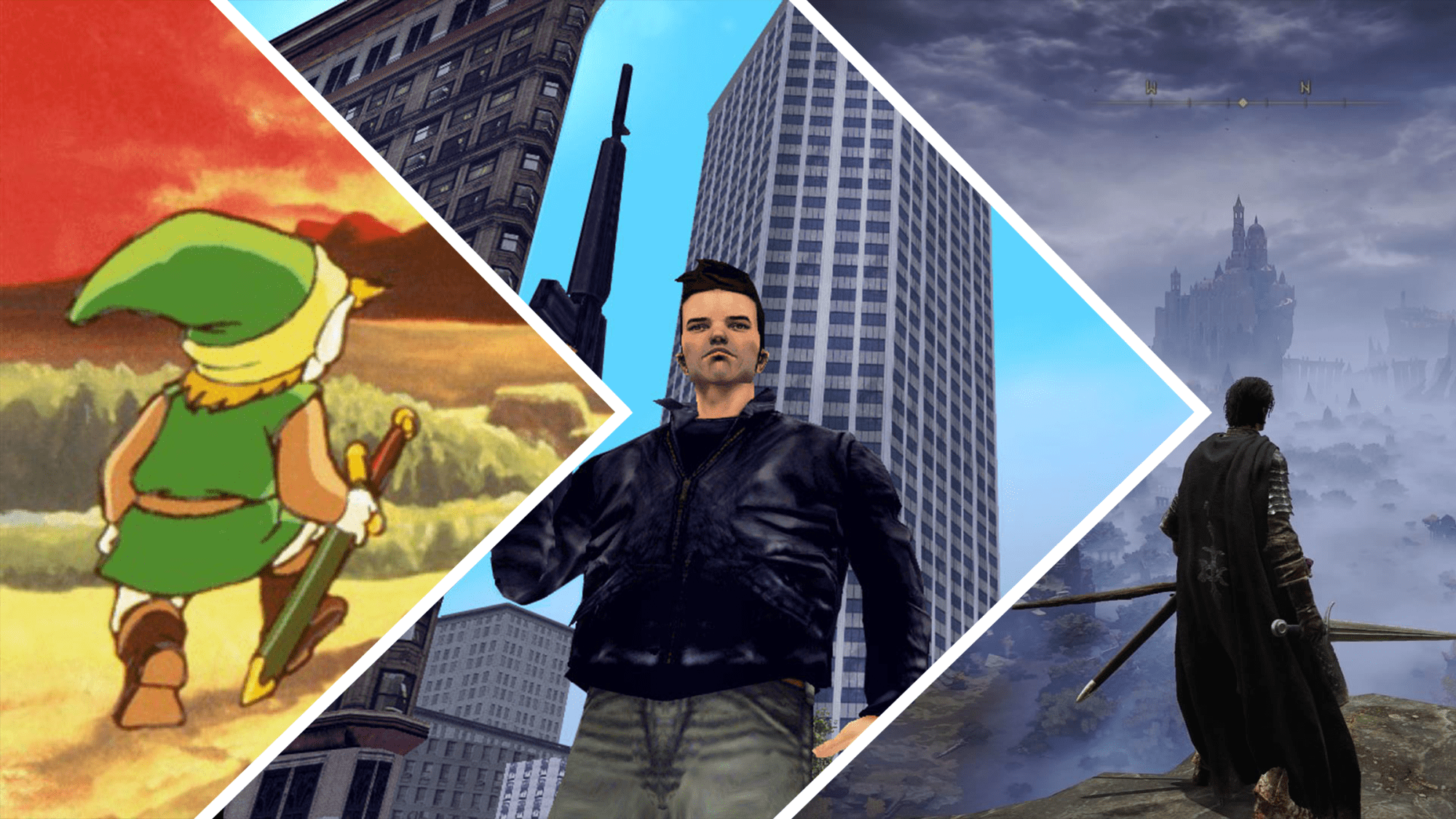
Best Open World Game From Each Console Generation
Open world games have come a long way since the 8-bit era. What started as simple top-down grids of pixels has evolved into massive, living, reactive worlds that span hundreds of hours of gameplay. Every console generation has pushed technical and creative boundaries, letting developers build bigger, more immersive sandboxes than ever before.
We’re breaking down the absolute best open world game from every major console generation, from the earliest home consoles to the current ninth generation of hardware. Whether you grew up with the NES or just picked up a PS5, there’s a classic (or modern masterpiece) here for you.
What Counts as an Open World Game?
For this list, we define open world games as titles that let you explore a large, continuous game world freely, without mandatory linear level gating (outside of optional progression locks for balance). We’re focusing on console releases, prioritizing games that defined or revolutionized open world design for their specific era.
First & Second Generations (1972–1983): No Open World Games
The earliest console generations (dedicated Pong consoles, Atari 2600, Intellivision) had no programmable open world games. All titles were linear, arcade-style experiences with no free exploration, so we start our list with the third generation where open world design first emerged.
Third Generation (1983–1987): The Legend of Zelda (NES)
The original The Legend of Zelda (1986) is widely credited as the first true open world game on home consoles. It threw players into the top-down world of Hyrule with nothing but a sword and total freedom to explore.
Why It Wins
- First mainstream open world on home consoles, with non-linear exploration that let players tackle dungeons in almost any order
- Introduced core open world staples like hidden secrets, item-based progression gating, and optional side content
- Tight, focused design that still holds up 40+ years later, with no wasted space in its small but dense map
Fourth Generation (1987–1993): The Legend of Zelda: A Link to the Past (SNES)
A Link to the Past (1991) took the open world foundation of the original and expanded it into two massive parallel worlds: Light Hyrule and Dark Hyrule.
Why It Wins
- Doubled down on non-linear exploration with two full worlds to traverse, each with unique secrets and dungeons
- Added deeper RPG elements, more complex puzzles, and a larger, more detailed map than the original
- Set the gold standard for 2D open world action-adventures, a formula still used in indie games today
Fifth Generation (1993–2000): The Legend of Zelda: Ocarina of Time (Nintendo 64)
The fifth generation marked the shift to 3D gaming, and Ocarina of Time (1998) led the charge for open world design. It was the first 3D game to let players freely explore a large, seamless open world.
Why It Wins
- Brought open world design into 3D for the first time, with seamless Hyrule Field exploration and no load screens between zones
- Introduced Z-targeting combat, time-travel mechanics, and a world that felt alive for its era
- Defined 3D action-adventure games for decades, with its influence visible in every open world game that followed
Sixth Generation (2000–2005): Grand Theft Auto: San Andreas (PS2/Xbox)
The sixth generation saw the rise of 3D open world games with real-world settings, and Grand Theft Auto: San Andreas (2004) was the peak of this era. It offered a massive open world set across three fictional cities.
Why It Wins
- Massive open world spanning three distinct cities, each with unique atmospheres, side quests, and secrets
- Added RPG stats (stamina, muscle, driving skill) and customizable vehicles, letting players tailor their experience
- Feature-rich with gang warfare mechanics, casino games, and a story that spanned 100+ hours of gameplay
Seventh Generation (2005–2012): The Elder Scrolls V: Skyrim (PS3/Xbox 360)
The seventh generation was the era of massive open world RPGs, and Skyrim (2011) became a cultural phenomenon that’s still played today.
Why It Wins
- Massive, fully voiced open world with hundreds of side quests, radiant AI that made NPCs feel alive, and deep crafting systems
- Infinite replayability via mods, which added new quests, graphics, and gameplay mechanics years after launch
- The definitive open world RPG of the 7th gen, with over 60 million copies sold worldwide
Eighth Generation (2012–2020): The Legend of Zelda: Breath of the Wild (Switch/Wii U)
The eighth generation saw open world games move away from hand-holding, and Breath of the Wild (2017) rewrote the rules entirely. It gave players total freedom to explore its massive map with no mandatory objectives.
Why It Wins
- Abandoned linear progression for total player freedom: climb any surface, paraglide across the entire map, solve puzzles however you want
- Physics-based interactions made the world feel reactive, with weather, fire, and gravity affecting gameplay naturally
- Redefined modern open world design, influencing every major open world release since 2017
Ninth Generation (2020–Present): Elden Ring (PS5/Xbox Series X)
The current ninth generation of consoles has already delivered a masterpiece with Elden Ring (2022), a collaboration between FromSoftware and George R.R. Martin.
Why It Wins
- Seamless, massive open world with no loading screens, even when fast traveling between distant zones
- Challenging Soulslike combat combined with hidden dungeons, optional bosses, and a story told through item descriptions and environmental clues
- The current gold standard for 9th gen open world games, winning over 300 Game of the Year awards
Honorable Mentions
Several other games almost took the top spot for their generation:
- Gen 6: Grand Theft Auto III (launched the 3D GTA franchise)
- Gen 7: Red Dead Redemption (set the standard for open world westerns)
- Gen 8: Red Dead Redemption 2 (the most detailed open world of its era)
- Gen 9: The Legend of Zelda: Tears of the Kingdom (expanded on Breath of the Wild’s formula)
Final Thoughts
Every console generation has built on the last, pushing open world games to be bigger, more immersive, and more player-focused. From the 8-bit Hyrule of the NES to the sprawling Lands Between of the PS5, these games represent the best of what each era had to offer.
What’s your favorite open world game from each console generation? Let us know in the comments below!

Comments are closed, but trackbacks and pingbacks are open.