

Can Brain Complexity Predict Stimulation Response?
A groundbreaking study published in Cerebral Cortex has investigated whether the complexity of brain activity at rest can predict how individuals respond to theta-burst stimulation (TBS)—a non-invasive brain stimulation technique increasingly used in research and clinical settings. The findings reveal both promise and significant limitations in using machine learning to forecast neurophysiological responses.
Understanding Theta-Burst Stimulation
Theta-burst stimulation is a form of transcranial magnetic stimulation (TMS) that delivers rapid bursts of magnetic pulses to the brain. Unlike conventional TMS protocols that require several minutes per session, TBS can produce similar effects in just a few seconds to minutes. This makes it particularly attractive for:
- Research applications studying brain plasticity
- Clinical trials investigating depression treatment
- Cognitive enhancement studies
- Rehabilitation after stroke or brain injury
However, individual responses to TBS vary dramatically. Some people show robust neurophysiological changes, while others show little to no response. Understanding this variability has become a major focus in the field.
The Complexity Approach: Measuring Resting State Dynamics
Researchers have long known that the brain never truly rests—even when we’re not actively engaged in tasks, spontaneous neural activity continues in complex, organized patterns. This ongoing activity can be quantified using mathematical measures of complexity, which capture the richness and unpredictability of brain signals.
The study employed sample entropy (SampEn)—a sophisticated algorithm that measures the complexity of time-series data from electroencephalography (EEG) recordings. Higher sample entropy indicates more complex, unpredictable brain dynamics, while lower values suggest more regular, repetitive patterns.
Machine Learning Methodology
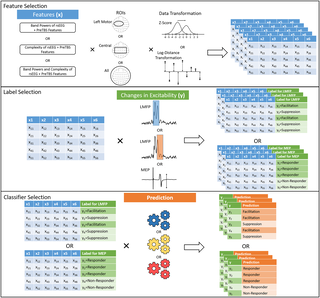
The research team took a rigorous approach to their predictive modeling:
- Data Collection: EEG recordings were obtained from participants during eyes-closed rest
- Feature Extraction: Sample entropy was calculated from multiple electrode sites across the scalp
- Machine Learning Algorithm: A support vector machine (SVM) was trained to classify individuals as "responders" or "non-responders" based on their resting-state complexity patterns
- Cross-Validation: The model was tested using rigorous validation procedures to assess its reliability
Key Findings: Promise and Limitations
Initial Predictive Success
The machine learning model demonstrated significant ability to predict TBS responses within the original dataset. Resting cortical complexity patterns contained meaningful information about how individuals would respond to stimulation. This finding aligns with theoretical expectations—baseline brain state likely influences how the brain responds to external perturbation.
The Generalization Problem
However, the study revealed a critical limitation: the predictive model failed to generalize. When researchers attempted to apply the trained model to new participants or different experimental sessions, prediction accuracy dropped substantially. This "overfitting" phenomenon—when a model learns training data too specifically rather than underlying patterns—represents a significant challenge for clinical translation.
Why Does Generalization Fail?
Several factors may explain why resting complexity fails to reliably predict TBS response across individuals:
- State Variability: Resting brain activity fluctuates naturally over time and across days
- Individual Differences: Baseline complexity may not capture the full picture of responsiveness
- Network Complexity: Single-region measurements may miss important interactions between brain areas
- Stimulation Factors: Parameters like intensity, location, and timing influence responses independently of baseline state
Implications for Future Research
Despite the limitations, this study makes important contributions to the field:
- It establishes feasibility: The initial predictive success within the training set proves that resting complexity contains TBS-relevant information
- It identifies challenges: The generalization failure highlights the need for more robust biomarkers
- It guides future directions: Multi-modal approaches combining complexity with other measures may prove more reliable
Future studies might benefit from combining resting complexity with:
- Functional connectivity measures
- Structural MRI data
- Genetic markers
- Behavioral measures
- Multiple rest sessions to account for state variability
Clinical Outlook
While the dream of personalized stimulation protocols based on simple baseline measurements remains unrealized, this research moves the field forward by systematically evaluating one promising approach. The authors emphasize that "negative" findings—demonstrating what doesn’t work—are equally valuable for guiding research priorities.
As machine learning techniques continue to advance and larger datasets become available, the prospect of reliably predicting individual responses to brain stimulation seems increasingly achievable. Until then, researchers continue to refine their approaches, one study at a time.
Conclusion
This rigorous machine-learning study demonstrates that resting cortical complexity contains predictive information about theta-burst stimulation responses—but not enough to enable reliable generalization across individuals. The findings underscore both the potential and current limitations of using baseline brain measures to personalize non-invasive brain stimulation. As the field matures, more sophisticated multi-modal approaches may ultimately succeed where single-biomarker strategies have fallen short.

Comments are closed, but trackbacks and pingbacks are open.